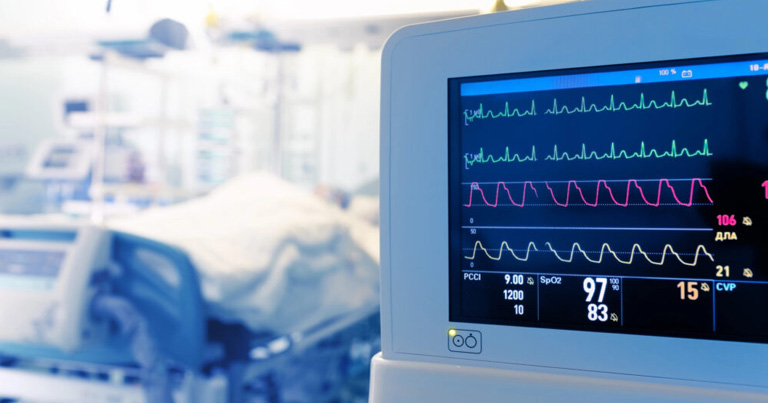
What is ICU?
If you or a loved one have ever been hospitalized, you may have heard the term “ICU” thrown around. But what exactly is an ICU? Here you wil…
Corrects the QT interval for heart rate by the Fridericia, Framingham or Bazett formula, and compares the result with that formula's upper limit of normal and with the thresholds the American Heart Association uses for drug-induced torsade de pointes.
Before the drug (optional)
| QTc | Meaning |
|---|---|
| At or below the upper limit for the formula and sex (next table) | Not prolonged |
| Above that limit | Prolonged (above the 99th percentile, AHA/ACCF 2010) |
| Above 500 ms | Highly abnormal; in congenital long QT syndrome a QTc above 500 ms carries 2 to 3 times the torsades risk |
| A rise of 60 ms or more from the pre-drug baseline | Like a QTc above 500 ms, calls for prompt action after a QT-prolonging drug |
| Formula | Upper limit, men | Upper limit, women |
|---|---|---|
| Fridericia | 448 ms | 468 ms |
| Framingham | 449 ms | 467 ms |
| Bazett | 472 ms | 482 ms |
The upper limits are the 99% upper limits of normal in the healthy subset of Vandenberk 2016. The AHA/ACCF statement gives about 470 ms in men and 480 ms in women as the 99th percentile; those values generally refer to Bazett, which reads higher than Fridericia whenever the heart rate is above 60/min.
Prompt action means considering another drug, looking for interacting drugs, slow heart rates and electrolyte problems, and keeping a defibrillator at hand. Each 10 ms rise in QTc adds roughly 5% to 7% to the torsades risk in congenital long QT syndrome, and no QTc makes torsades certain. Measure the same lead with the same method and formula each time. A new bundle branch block lengthens the QT without adding torsades risk; in atrial fibrillation, one approach is to average the QTc of the shortest and longest RR intervals.
RR interval (s) = 60 ÷ heart rate
Fridericia: QTc = QT ÷ RR1/3
Framingham: QTc = QT + 154 × (1 − RR)
Bazett: QTc = QT ÷ RR1/2
QT and QTc are in ms and RR in seconds. Fridericia is the default. Bazett reads long at faster heart rates, especially above 85/min, and short at slow rates. With a baseline QT and heart rate entered, the baseline QTc uses the same formula, so the change is comparable.
Sagie and colleagues derived the Framingham correction from 5,018 people in the Framingham Heart Study, in whom Bazett overcorrected at fast rates and undercorrected at slow ones. In 6,609 hospital patients in Leuven, Fridericia and Framingham removed the effect of heart rate best and predicted 30-day and 1-year mortality better than Bazett. In the healthy subset, the 99% upper limits were 448 ms in men and 468 ms in women with Fridericia, 449 and 467 with Framingham, and 472 and 482 with Bazett; the Fridericia and Framingham limits sat close to the common clinical cut-offs of 450 ms in men and 470 ms in women. With Bazett, up to twice as many patients about to start haloperidol were flagged as at risk. The AHA/ACCF statement treats a QTc above the 99th percentile as prolonged and above 500 ms as highly abnormal.
If you or a loved one have ever been hospitalized, you may have heard the term “ICU” thrown around. But what exactly is an ICU? Here you wil…
You just received a call from the hospital that your loved one is admitted to ICU. This sounds scary. You already know what is ICU, but you…