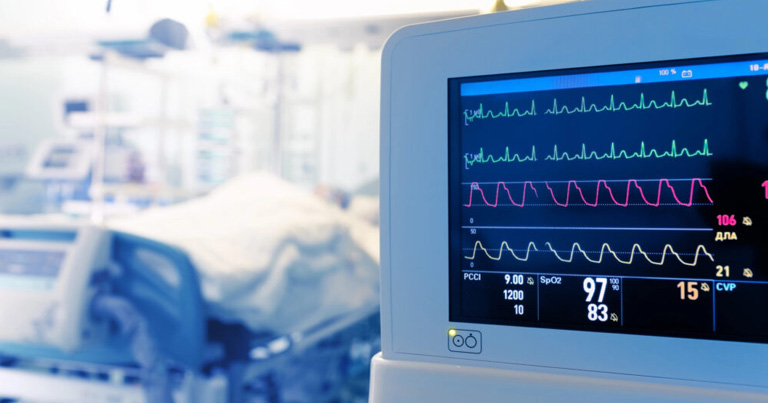
What is ICU?
If you or a loved one have ever been hospitalized, you may have heard the term “ICU” thrown around. But what exactly is an ICU? Here you wil…
Stages acute kidney injury in adults by the KDIGO 2012 criteria: the rise in serum creatinine from baseline to its peak, the urine output and the start of renal replacement therapy.
| Stage | Serum creatinine | Urine output |
|---|---|---|
| 1 | 1.5-1.9 times baseline, or a rise of 0.3 mg/dL (26.5 µmol/L) or more within 48 hours | Below 0.5 mL/kg/h for 6-12 hours |
| 2 | 2.0-2.9 times baseline | Below 0.5 mL/kg/h for 12 hours or more |
| 3 | 3.0 times baseline or more, a rise to 4.0 mg/dL (353.6 µmol/L) or more, or renal replacement therapy started | Below 0.3 mL/kg/h for 24 hours or more, or no urine for 12 hours or more |
AKI is present when creatinine rises by 0.3 mg/dL or more within 48 hours, or to 1.5 times baseline or more within the prior 7 days (known or presumed), or when urine output stays below 0.5 mL/kg/h for 6 hours. The stage is the highest that any criterion reaches. A creatinine of 4.0 mg/dL or more counts for stage 3 only once the creatinine part of the definition is met, so a stable high creatinine in chronic kidney disease is not stage 3 AKI.
The 48-hour and 7-day windows are for diagnosing AKI, not for staging it: once the definition is met, the stage comes from the peak creatinine over the whole episode. In the guideline's example, a 50% rise within 5 days that reaches three times baseline over 3 weeks is stage 3. A rise that takes more than 7 days to reach the definition is not AKI by creatinine.
KDIGO released a draft update of its AKI and acute kidney disease guideline for public review in March 2026; comments closed on May 11, 2026. The draft keeps similar creatinine and urine output thresholds and adds cystatin C and kidney damage biomarkers. It has not been published in final form and states that its content will change, so this calculator follows the 2012 guideline.
Creatinine ratio = peak creatinine ÷ baseline creatinine
Creatinine rise = peak creatinine − baseline creatinine
Urine output (mL/kg/h) = urine volume (mL) ÷ weight (kg) ÷ hours
Stage = the highest of the creatinine stage, the urine output stage, and 3 if dialysis has started
Creatinine converts at 1 mg/dL = 88.4 µmol/L. A rise counts at 0.3 mg/dL or at 26.5 µmol/L, the two forms the guideline gives. Ratios are compared unrounded, and the ratio shown is cut, not rounded, to two decimals. The criterion of a fall in eGFR below 35 mL/min per 1.73 m2 applies only to patients under 18 and is left out.
The KDIGO criteria merge the earlier RIFLE and AKIN definitions, which studies of more than 500,000 patients tied to death and the need for renal replacement therapy. Risk of both rises with each stage, and AKI raises the later risk of chronic kidney disease, cardiovascular disease and death even after creatinine recovers. In a direct comparison, RIFLE missed 9% of the cases AKIN found and AKIN missed 26.9% of the cases RIFLE found, so KDIGO kept elements of both.
If you or a loved one have ever been hospitalized, you may have heard the term “ICU” thrown around. But what exactly is an ICU? Here you wil…
You just received a call from the hospital that your loved one is admitted to ICU. This sounds scary. You already know what is ICU, but you…